
Your business has a privacy policy. It's on your website, and somebody smart wrote most of it years ago. And the last real change was the office address. Now there's a new rule from 10 December. So you're waiting for an updated privacy policy template from an Australian industry body or the law firm you use. When it arrives, you'll swap it in, get someone to make sure there are no spelling mistakes, and get back to doing real work.
For most of a privacy policy, that's a perfectly good plan. Collection, storage, access requests, how to complain: those paragraphs are much the same at every firm, and a template does them well.
The new section is different. It asks you to describe what your own software decides about people. A template written for 1,000 firms doesn't know yours intimately.
What's changing on 10 December
From 10 December 2026, new Australian Privacy Principles 1.7 to 1.9 kick in. If your firm uses a computer program (even an Excel spreadsheet) to make a decision about a person, or to do something substantially and directly related to that decision, and it uses their personal information to do it, your privacy policy has to say this directly.
So what does APP 1.8 ask for? It asks for the kinds of personal information the programs use. It asks for the kinds of decisions made solely by a program. And it asks for the kinds of decisions where a program does a large part of the work before a person signs off on it.
I wrote about how wide "computer program" reaches last month. The short version is that it's a lot wider than AI. A spreadsheet formula that scores clients counts as much as a chatbot.
It applies to APP entities, which for most private firms means turnover above $3 million. Below that line you're generally exempt, though accounting and legal practices have lost some of that cover since 1 July, which I covered separately.
Limitations of a privacy policy template
Here's what a template can do. It can tell you the section needs to exist and hand you a sentence that sounds like compliance.
What it can't tell you is whether your practice management software puts a client's work on hold when an invoice is overdue. It can't know whether your job ads go through to SEEK with a screening question that closes applications no one's seen. It doesn't know if the CRM scores enquiries, or if the onboarding form turns someone away when their ID check fails.
So the template does the only thing it can. It writes in general terms. Something like "we may use automated tools and technology to support decision-making and improve our services".
And that's the problem with a template. The regulator explained this in their example. So it needs your input.
The OAIC's fact sheet on the new rule includes an example of an organisation describing its use of personal information to "support decision-making, administrative action [and] workflow automation", and says that's unlikely to give an ordinary person a meaningful understanding of what happens to their information. That's from Squire Patton Boggs' summary of the OAIC guidance, published after the regulator released it on 30 September. Corrs Chambers Westgarth put it more bluntly back in September: generic statements about "using technology to improve services" won't do.
Beware: A sentence that starts "we may use" is usually a sign the writer didn't know what you actually use. That's fine for a template. It's a problem once it's published in your policy.
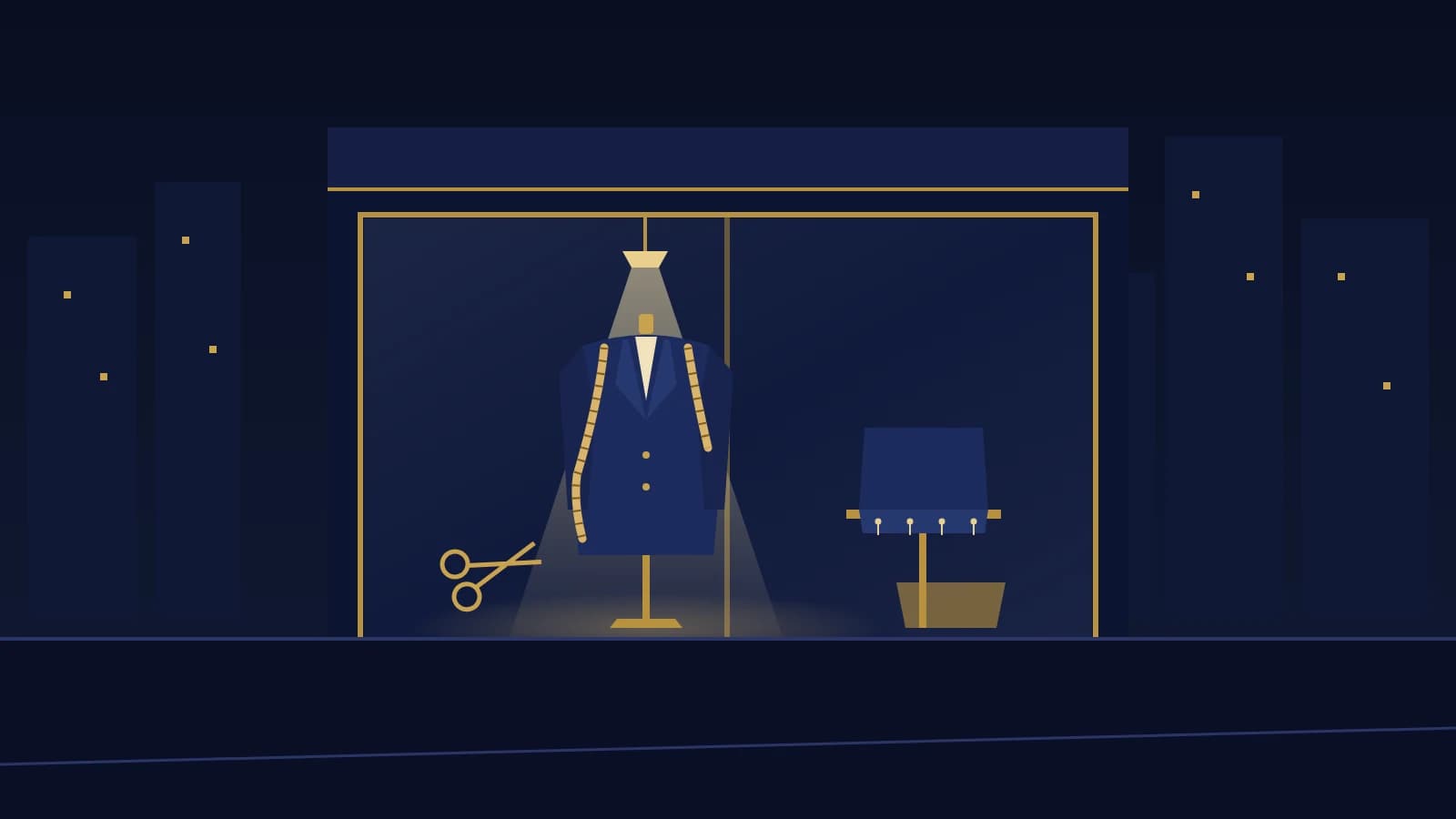
The off-the-rack suit
A good off-the-rack suit fits most people across the shoulders. That's the template. It's well made and it does most of the job.
But nobody walks out of the shop with the trousers unhemmed (unless you're 20 years old and it's your first suit). Somebody kneels down with a tape measure and pins the hem to your leg, because the factory had no way of knowing how tall you are.
The automated decisions section is the hem. It's the one part that has to be measured on you.
What a fitted section looks like
Ours is on the site if you want to see how specific it gets. Our privacy statement identifies TestGorilla and states that it scores and ranks job applicants, and that interview decisions rely mainly on those scores. It says a SEEK screening answer that fails a role requirement closes the application automatically, and that nobody at Intuitive IT reviews applications closed that way. It says clicking a simulated phishing link assigns you a training module with no person involved.
We make it clear that when a support request comes in, my team starts with what the triage tool considers urgent rather than a blank page.
I'll admit I had Claude do the groundwork for this area, and when it raised what needed to go in, I felt a little uncomfortable. But trust comes from transparency. I decided to include this information in our policy to make it clear how we use technology. Because no one truly believes a tech company isn't using tech to make decisions.
That's what the OAIC means by meaningful. Someone reading it can work out which decision affected them, what information went into it and whether someone looked.
The guidance isn't asking for a technical manual. The Allens summary of the guidance reads it as allowing you to group similar decisions together, with no need to explain the inner workings of the software. Grouping's a good idea, but being vague isn't.
Tip: Write each decision the way a client would describe it to a friend. "If your ID check fails twice, your account won't open until one of our team calls you." If a client can't recognise themselves in the sentence, it's still a template.
Why vague reads worse than you'd think
The OAIC's 2026 Australian Community Attitudes to Privacy Survey found that just 4% of Australians think AI companies are worthy of their trust.
Four in a hundred. Put that next to a privacy policy that says "we may use automated tools and AI to support our decisions", and think about who reads it. It's the applicant who never heard back. Or it's the family office's lawyer, doing due diligence on you before they move $40 million across.
I don't think any of them read "may use AI" as modern. They read it as a firm that either doesn't know what its systems do or doesn't want to say (or doesn't care?). For a business whose whole product is trust and discretion, it isn't a great look.
Being specific has the opposite effect. "Our software flags large transfers for one of our team to review before they go through" tells a client exactly what happened and that a human was involved. It's the same instinct as the eight questions I'd answer before downloading an AI policy template: the document is the easy bit, and the answers have to come from inside the firm.
Who has to do the measuring
This is where firms get stuck. The person who'll update the wording is usually the practice manager or the firm's lawyer. Neither of them set up the CRM workflow in 2021, or knows the ATS has a knock-out question, or that an AI tool drafts the first pass of the file note a planner relies on.
So the privacy policy template, written for Australian firms in general, arrives. It reads well and it gets published. And the one section the regulator is actually looking at describes nobody's systems in particular.
The wording is a question for your lawyer. The list of what your software decides is a question for whoever runs your systems. For a lot of firms that's an IT provider, and I'd ask them for that list in writing. Recruitment firms in particular have more of these decisions than they think, which is why we wrote one just for them.
At the time of writing, I don't know how hard the OAIC will push in the first year. It ran its first privacy policy compliance sweep this year, across 60 businesses, so it's clearly reading policies. Are you willing to bet the firm's name on a quiet start?
One thing to do now
Before the updated template arrives, sit down with whoever knows the systems for half an hour. Write a list of every piece of software that says yes, no or "you first" about a person, and next to each one, whether a person weighs it before it sticks.
That list is the tape measure. Hand it to whoever is updating the policy, and the template's general sentence becomes three or four specific ones about your firm. Without it, you've bought a good suit and you're wearing it with the trousers dragging on the ground (like I did when I was 20).
If you'd like a second look before your lawyer sees it, our free AI Privacy Policy Checker reads your published policy against the three APP 1.8 items in about two minutes. And if the list of systems is the hard part, send us what you've got and we'll tell you which ones we'd expect to need a line.
Yener
Where these numbers come from
- Australians more concerned about privacy as trust in AI languishes, survey finds, OAIC (Australian Community Attitudes to Privacy Survey 2026, fieldwork March 2026)
- APP 1.7–1.9 Transparency Obligation Fact Sheet, OAIC, 30 September 2026
- Who decides? Australia's new guidance on automated decision-making raises the bar, Squire Patton Boggs, October 2026
- Automated decision-making: preparing for the new transparency obligation, Corrs Chambers Westgarth, 8 September 2026
- Mandatory automated decision-making disclosure requirements are coming: key takeaways from the OAIC guidance, Allens, October 2026
- The OAIC privacy sweep in 2026, Maddocks
